
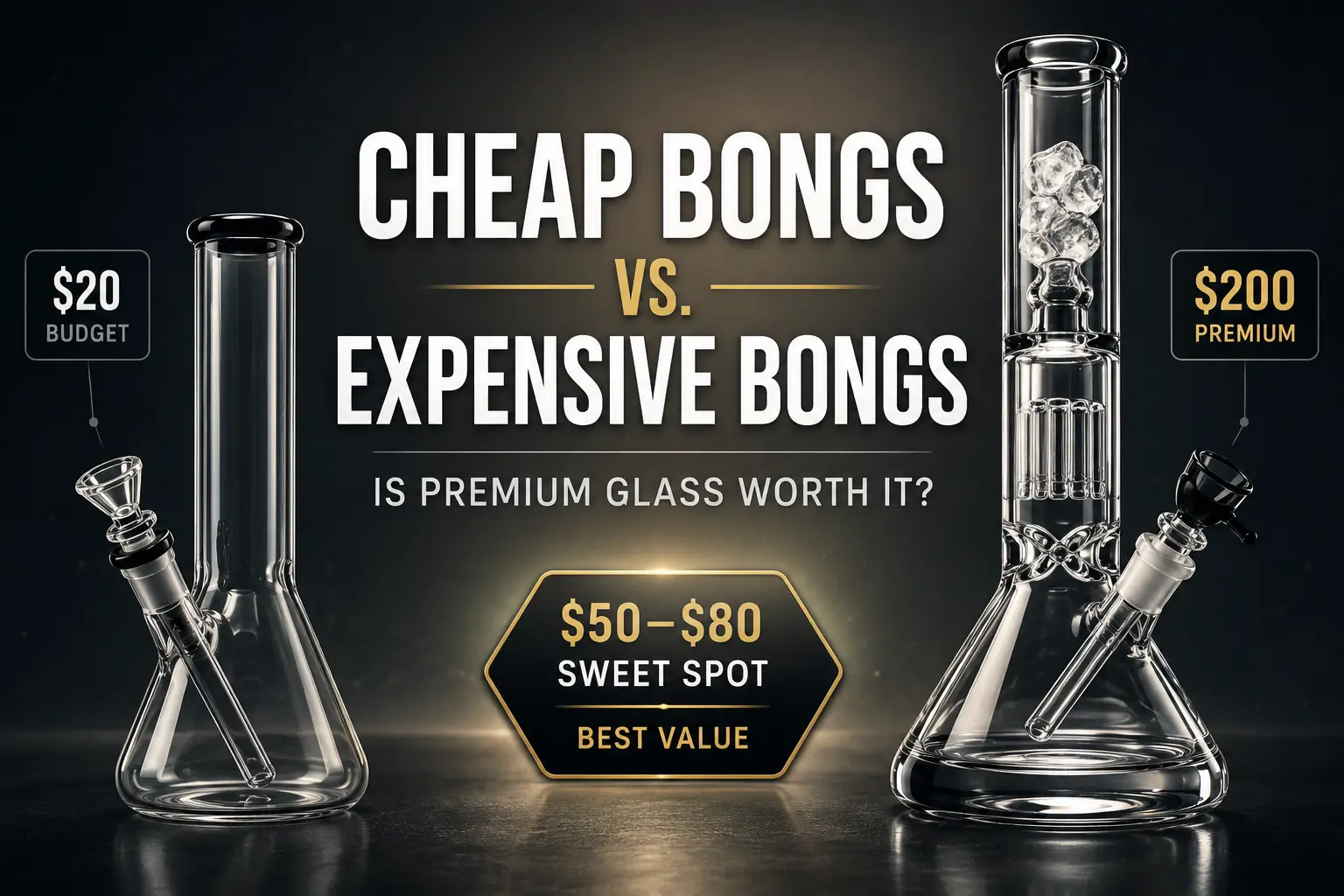
A $20 bong and a $200 bong both hold water and burn weed. So why does one cost ten times more — and is the difference something you’d actually feel during a session?
I’ve owned cheap bongs that survived three years of daily use and expensive bongs that cracked the second week. I’ve also owned budget glass that tasted like sucking on a penny and premium pieces that delivered hits so smooth I forgot I was smoking. The truth about cheap bongs vs expensive bongs isn’t a simple “you get what you pay for.” It’s messier, more interesting, and — if you know what to look for — way more in your favor than the price tags suggest.
What Actually Changes Between Cheap Bongs and Expensive Bongs
Before getting into specifics, here’s the big picture. Not every difference between a cheap bong and an expensive bong is visible on the shelf. Some you only notice after a month of daily use. Others hit you on the very first pull.
Here’s what generally separates the two:
Cheap bongs ($10–$35) typically have:
- Soda-lime glass (the same glass as window panes)
- Thin glass walls — often under 3mm
- Rubber grommet joints instead of ground glass
- No percolator, no ice catcher, no splash guard
- Simple straight tube or basic beaker shapes
- Minimal quality control — uneven seams, wobbly bases
Expensive bongs ($100–$300+) typically have:
- Borosilicate glass (lab-grade, heat resistant)
- Thick glass walls — 5mm or above
- Ground glass joints for airtight seals
- Built-in percolators, ice catchers, splash guards
- Multiple chambers and removable parts
- Hand-finished details, custom artwork, and artistic designs
The gap is real. But here’s the thing most articles won’t tell you: the biggest quality jump doesn’t happen at the top of that range. It happens in the middle — around $40–$80. That’s where you cross from cheap materials into quality materials without paying for the brand name premium.
Understanding parts of a bong helps here. When you know what a downstem, joint, and perc actually do, you can spot where a manufacturer cut corners — regardless of the price tag.
Are Expensive Bongs Really Better Than Cheap Ones?
Usually, yes — but with a giant asterisk.
A $60 borosilicate glass beaker with a simple diffused downstem will outsmoke a $180 novelty piece with a complicated multi-chamber design that’s hard to clear and impossible to clean. Price doesn’t always equal performance. What matters is where the money goes.
If the higher price tag pays for better glass, tighter joints, and functional filtration — that’s a real upgrade. If it pays for a brand name, custom artwork, or a shape that looks cool on a shelf but smokes like a clogged drainpipe — you’re overpaying for decoration.
The Biggest Difference Your Money Buys
If you only care about one difference between cheap bongs and expensive bongs, make it this one. Glass quality determines how your piece handles heat, how it tastes, how long it lasts, and how likely it is to shatter when you bump a table edge.
Two types of glass dominate the bong market:
| Feature | Soda-Lime Glass | Borosilicate Glass |
|---|---|---|
| Cost | Cheap — bulk manufactured | Higher — requires specialized production |
| Heat Resistance | Low — expands when heated, prone to thermal shock | High — designed to resist thermal shock |
| Durability | Brittle at thin gauges | Stronger at the same thickness |
| Taste | Can impart slight off-flavors | Completely neutral — no flavor transfer |
| Common In | Gas station bongs, sub-$25 pieces | Mid-range to premium glass bongs, lab equipment |
When I first switched from a $22 soda-lime piece to a $55 borosilicate beaker, the taste difference surprised me more than anything. The cheap one always had a faintly metallic, stale quality — especially on the first few hits after cleaning. The borosilicate piece? Nothing. Just smoke. Clean, neutral, exactly what the flower tasted like on its own.
That neutrality isn’t an accident. Research on glass composition and chemical stability confirms that borosilicate glass resists leaching at temperatures well above what a bong session reaches. Soda-lime glass is far more reactive, especially when combined with heat from a lighter and acidic resin buildup.
Most budget bongs at reputable shops — including the glass bongs at BongHaus — now use borosilicate even at lower price points. The real red flag isn’t price; it’s when a listing doesn’t specify the glass type at all.
How Thick Should Bong Glass Be?
Glass thickness is the quickest way to judge durability without even smoking from a piece. Here’s the breakdown:
- Under 3mm — Common in the cheapest bongs. Feels flimsy. Will crack easily from a short drop or a sudden temperature change. Fine as a temporary backup, not a daily driver.
- 3–5mm — The sweet spot for most smokers. Solid enough to survive normal handling. This is where many budget bongs ($35–$70) with borosilicate glass live — and where your money starts buying real resilience.
- 5mm and above — Premium territory. These pieces can take a bump against a counter without shattering. You’ll find this glass thickness in high end bongs and anything marketed as “scientific glass.”
My rule of thumb: if a bong feels light enough to mistake for plastic, the glass is too thin. Pick it up. If it has some weight to it, the walls are doing their job.
Features You Get at Each Price Range
Glass quality is the foundation, but features are where price tiers really start to show their hand. Here’s what typically unlocks as you move up:
$10–$30 (Entry Level)
- Basic straight tube or small beaker
- Rubber grommet joint
- Simple carb hole or slide bowl
- No percolator, no ice catcher
- Often acrylic bongs or mini bongs at this floor
$30–$70 (The Sweet Spot)
- Borosilicate glass with 3–5mm walls
- Ground glass joint (14mm or 18mm)
- Ice catchers or ice pinchers built into the neck
- Basic diffused downstem
- Some include a simple tree perc or honeycomb perc
- Removable parts — bowl and downstem separate for cleaning
$70–$150 (Mid-Premium)
- Thick glass (5mm+)
- Built-in percolator — showerhead, tree, or inline
- Splash guards to prevent water reaching your mouth
- Ash catcher compatibility (ground glass joint allows add-ons)
- Multiple chambers for extra filtration
- More unique shapes and color work
$150–$300+ (Premium / Collector)
- Hand-blown by named glass artists
- Multi-perc systems with multiple chambers
- Custom artwork, fuming, color-changing effects
- Limited runs or one-of-a-kind intricate pieces
- Brand prestige (popular brands, gallery-quality design)
The pattern is clear: every dollar between $30 and $100 buys you a tangible functional upgrade. Above $100, you’re increasingly paying for artistic designs, brand reputation, and craftsmanship — real value, but not the kind that changes how your hit feels.
For most daily smokers, the $40–$80 range delivers everything that matters. A Percolator Bong with an ice catcher in that range will outperform a plain $200 tube every single time.
What Makes a High Quality Bong?
Forget the logo. A genuinely high quality bong has five measurable traits:
- Borosilicate glass — non-negotiable for any piece you plan to use regularly
- Ground glass joints — 14mm or 18mm, no rubber grommets. Airtight seal = better suction and no air leaks
- Consistent wall thickness — hold it up to light and check for thin spots. Quality glass is uniform
- Functional percolator — not just decorative. It should visibly break smoke into small bubbles when you pull. Our breakdown on what is a percolator bong explains each type
- Stable base — wider than the mouthpiece. A Beaker Bong shape is the most tip-resistant design
If a piece checks all five boxes, it’s a quality bong — whether the price tag says $50 or $250.
Do Cheap Bongs Actually Break Easier?
This is the question that keeps budget shoppers up at night. And after breaking more bongs than I’d like to count across 8+ years, here’s the honest answer: it depends entirely on the glass, not the price.
A $30 durable bong made from 4mm borosilicate glass will survive more abuse than a $130 art piece with 3mm soda-lime walls and a top-heavy design. I’ve seen it happen. I’ve lived it — my most durable piece ever was a $45 beaker from a lesser known brand that I used as my daily driver for two straight years, including taking it camping twice.
On the other hand, those $12–$18 gas station specials? They break easily. Not because they’re cheap in theory, but because they’re cheap in practice — thin glass, poor annealing (the cooling process that strengthens glass), and stress points at the joints where the bowl meets the body.
Silicone bongs and acrylic bongs are worth mentioning here. If your primary concern is something that won’t shatter, are silicone bongs safe answers the safety question — and yes, food-grade silicone is virtually unbreakable. The trade-off is taste and aesthetics, but for travel or clumsy hands, they’re legitimate alternatives.
Is It Cheaper to Buy One Expensive Bong or Keep Replacing Cheap Ones?
Let’s do the math most people skip.
Scenario A — Budget replacements:
- $25 cheap bong × 3 replacements per year = $75/year
- Each piece lasts ~4 months before cracking, tipping, or a joint snapping off
Scenario B — One quality piece:
- $65 borosilicate bong × 1 purchase = $65 total
- Lasts 2–3 years with normal care (some last 5+)
Cost per day of use:
- Scenario A: $75 ÷ 365 = $0.21/day
- Scenario B: $65 ÷ 1,095 (3 years) = $0.06/day
The “expensive” bong costs a third as much per use. And that doesn’t factor in the frustration of breaking a piece mid-session, running to a smoke shop for a replacement, or the waste of throwing away cracked glass every few months.
If you want to save money long-term and prioritize durability, spending $50–$80 once beats spending $25 three times. Browse cheap bongs that actually use borosilicate glass — the upfront price is low, but the lifespan is long.
Can You Actually Tell the Difference?
Here’s where the debate gets personal. Some smokers swear they can taste the difference between a $30 bong and a $100 one. Others say smoke is smoke. After years of switching between price tiers, here’s what I’ve found:
Yes, you can tell — but the difference isn’t where most people think it is.
The biggest taste factor isn’t the glass walls. It’s what sits between the bowl and your mouth: the downstem material, the joint type, and whether the piece has a percolator.
Cheap bongs with metal downstems produce a noticeable metallic flavor, especially when the metal heats up during longer sessions. Rubber grommet joints add a faint rubbery note that’s subtle but there. Neither of these issues exists in a piece with a glass downstem and ground glass joint — and you can get those features for $40.
Percolation matters too. A bong with even a basic percolator splits smoke into dozens of tiny bubbles, increasing the surface area that contacts water. Studies on water pipe filtration show this process filters out some particulates and cools the smoke, producing smooth hits with less throat burn. That’s not a $200 feature — a $55 Percolator Bong delivers the same benefit.
Where diminishing returns kick in: once you have borosilicate glass, a glass downstem, and a single percolator, adding a second perc chamber or a fancier design improves smoothness only slightly. The jump from no-perc to one-perc is dramatic. The jump from one-perc to three-perc is marginal.
Why Do Some Cheap Bongs Leave a Weird Taste?
Three common culprits:
- Metal downstems — Aluminum or zinc alloy downstems are common in sub-$25 pieces. They conduct heat, oxidize over time, and impart a metallic flavor that coats every hit.
- Rubber grommets — Instead of ground glass joints, cheap bongs use rubber rings to seal the downstem. Heat + resin + rubber = a faint but persistent off-taste.
- Residual manufacturing chemicals — Low quality materials and rushed production sometimes leave flux residue or adhesive traces inside the glass. You might notice this most on the first few uses before it burns off.
The fix is straightforward: buy a bong with an all-glass airpath. Glass bowl, glass downstem, ground glass joint. That eliminates every source of unwanted flavor. You can find this setup starting around $35–$45 — it doesn’t require high end bongs money.
For the cleanest possible taste, pair your piece with proper water levels. Our guide on how much water to put in a bong covers the sweet spot for every bong shape.
How Much Should You Actually Spend?
After all the material science and feature breakdowns, here’s what it comes down to: where does your dollar stop making a real difference?
I’ve spent years bouncing between price tiers, and the pattern is consistent. The leap from $15 to $50 transforms every aspect of your smoking session — taste, smoothness, durability, and enjoyment. The leap from $50 to $150 improves things further, but less dramatically. And the leap from $150 to $300+? That’s almost entirely about aesthetics, collectibility, and brand reputation.
Here’s my honest spending guide based on how you smoke:
- $25–$40 — Best for beginners and backup pieces. You can land a solid borosilicate beaker or mini bong with a ground glass joint. No percolator at this level, but the glass is real and the hits are clean. Check how much is a bong for more context on what each price range gets you.
- $50–$80 — The sweet spot for 90% of smokers. Borosilicate glass, a functional percolator, ice catcher, removable downstem. This is where you get quality bongs without paying the brand tax. My personal daily driver lives in this range and has for years.
- $100–$200 — Premium daily drivers. Thicker glass (5mm+), advanced perc systems, splash guards, and nicer aesthetics. Worth it if smoking is a daily ritual and you want the piece to feel special every time.
- $200+ — Collectors and connoisseurs. Hand-blown, artist-signed, limited edition. These are high end pieces you display. The function isn’t dramatically better than the $80–$150 tier, but the craftsmanship and exclusivity are real.
The $50–$80 range is where I point everyone who asks me, “What should I buy?” It’s the floor for getting every feature that actually changes how your bong smokes, without a single dollar wasted on hype.
How Much Should You Spend on a Bong?
That depends on one question: how often do you smoke?
If you smoke once or twice a week, a $30–$40 piece handles everything you need. Borosilicate glass, clean flavor, and enough durability for casual use. No reason to spend more unless you just want a prettier piece.
If you smoke daily, bump to $50–$80. The percolator and ice catcher in this range aren’t luxuries — they reduce throat irritation over hundreds of sessions. Your lungs will notice the difference after a month.
If smoking is a social thing and you want a centerpiece, $100–$150 gets you something beautiful and functional. Popular brands in this range often include ash catcher compatibility and upgraded perc designs.
And if you want a one-of-a-kind piece from an independent artist? Budget $200+, but know you’re paying for the art, not a fundamentally different hit. For first-time buyers who want guidance on narrowing it down, our bong buying guide walks through every decision point.
Cheap or Expensive
Here’s an equalizer most comparison articles skip: maintenance matters more than price.
A $30 bong cleaned weekly will outperform and outlast a $150 bong that’s never been touched with isopropyl alcohol. Resin buildup restricts airflow, turns your water brown, and makes every hit taste like yesterday’s session. That’s true regardless of what you paid.
Here’s the care routine I follow and recommend:
- Change water after every session. Old water = stale taste and bacteria. Takes 30 seconds.
- Rinse with hot water after every 2–3 sessions. Melts loose resin before it hardens. This alone extends cleaning intervals significantly.
- Deep clean weekly. Isopropyl alcohol (90%+) and coarse salt. Pour in, shake for 60 seconds, rinse thoroughly. For detailed steps, our guide on how to clean a bong covers every method including alcohol-free options.
- Clean removable parts separately. Pull the bowl and downstem, soak in iso for 10 minutes, rinse. Resin loves to hide in removable parts and joint connections.
For intricate pieces with multiple chambers or detailed artistic designs, use pipe cleaners or small brushes to reach internal surfaces. More frequent cleaning is needed because complex designs have more surface area for resin buildup.
Do Expensive Bongs Need More Cleaning?
Yes — and that surprises people.
High end bongs with multiple percolators, multiple chambers, and winding internal pathways trap more resin in more places. A simple beaker has one chamber and one downstem to clean. A triple-perc recycler has six or seven surfaces collecting residue.
This doesn’t mean expensive pieces are worse — the filtration those features provide is genuine. But there’s a real trade-off: smoother hits come with more frequent cleaning. If you hate maintenance, a well-made single-perc beaker in the $50–$70 range gives you 80% of the smoothness with half the cleaning effort.
The comparison matters because bong pricing isn’t just the sticker on the shelf. Factor in cleaning supplies, replacement smoking accessories (bowls, downstems, ash catchers), and your time. A simpler piece at a lower price might genuinely cost less to own over a year than an elaborate one — especially for people who are honest about their cleaning habits.
If you want a shape comparison to help decide between easy-to-clean designs, beaker vs straight tube breaks down the pros and cons of each.
FAQs
Are expensive bongs really better than cheap ones?
In most cases, yes — but with serious diminishing returns. The biggest quality jump happens between the $15–$30 range and the $50–$80 range, where you get borosilicate glass, ground glass joints, and functional percolators. Above $150, improvements are incremental: thicker glass, hand-blown artistry, brand reputation. A $60 piece with the right features can easily match a $200 piece in actual smoking experience.
What is the difference between cheap and expensive glass?
Cheap bongs typically use soda-lime glass — thinner, less heat resistant, and prone to cracking from temperature changes. Expensive bongs use borosilicate glass — thicker, thermal shock resistant, and completely neutral in taste. The glass type affects durability, flavor, and how long the piece lasts. Many mid-range bongs ($40–$70) now use borosilicate, so you don’t need to spend $150+ for premium glass.
Do cheap bongs break easily?
It depends on the glass type and glass thickness — not just the price. Budget bongs made with thin glass (under 3mm soda-lime) can crack easily from minor impacts or temperature changes. However, cheap bongs made with borosilicate glass (3mm+) hold up surprisingly well. The material matters far more than the price tag alone.